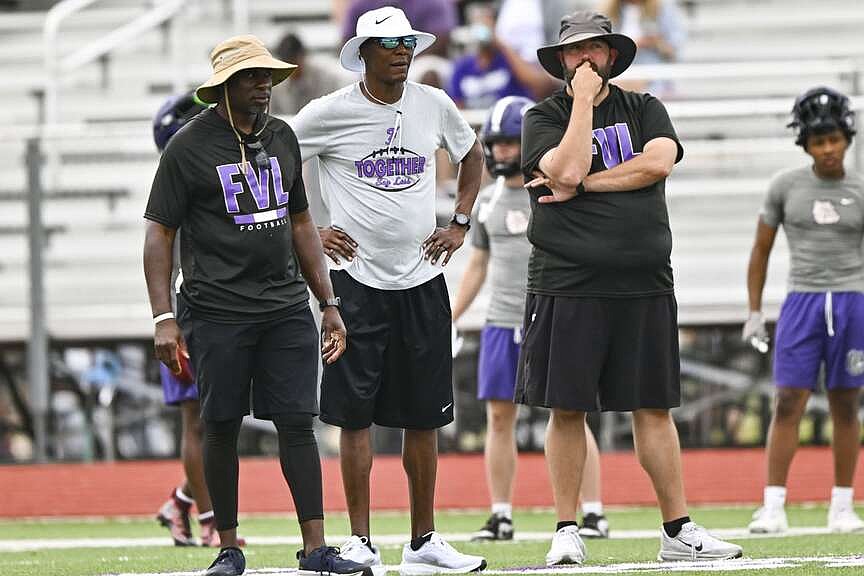
Fayetteville High School’s football team is showing steady progress under head coach Anthony Lucas as the season edges closer, despite the hot August weather. Lucas said his team has notably improved since the first days of practice and is adapting well to the often oppressive summer heat, a key factor for prep teams in Northwest Arkansas.
Since the practices kicked off earlier this month, Lucas has noticed better execution on both sides of the ball and increased stamina among his players. That’s no small feat through the sweltering heat Fayetteville regularly endures in late summer, especially under the glare of stadium lights and the grind of back-to-back practices.
The team has been holding practices at the school’s field on Tiger Avenue, capitalizing on the early morning hours whenever possible to avoid the worst of the midday heat. Coach Lucas has added cooling breaks and hydration reminders as routine, a practical measure in a region where summer temps often soar into the high 90s.
“We’re seeing guys push through the heat better than I expected for this time of year,” Lucas said recently. “Our conditioning program is paying dividends, but it’s also about knowing when to take care of yourself so you can compete at your best.”
Lucas, a Fayetteville native, took over the program last year with the goal of turning around a team that struggled in recent seasons. His focus throughout spring and summer training has been twofold: sharpen fundamentals and build physical endurance. So far, preseason scrimmages underscore his claims. The Tigers executed cleaner routes and displayed tighter tackling than in years past.
Lucas isn’t just relying on natural toughness; he’s leaned on sports science and modern training techniques to keep players safe and effective. For example, the staff has incorporated heat acclimation protocols, gradually increasing practice intensity so players’ bodies can better adjust to the local climate. It’s a proactive step that fits with how high school football programs in Benton County and beyond are evolving.
“The kids know they have to push their limits, but they also understand that overexertion in these temperatures can set back progress,” Lucas explained. “We’ve been educating them on how important it is to listen to their bodies.”
Assistant coaches have played a big role in monitoring the athletes. Athletic trainer Morgan Stevens has worked closely with the team during drills, ensuring players stay hydrated and that any signs of heat exhaustion are addressed immediately.
Lucas credits the summer conditioning leader, senior linebacker James Randall, for helping set the tone. Randall has been vocal about encouraging younger teammates to keep up their water intake and seek shade during breaks. His leadership helped foster a team-wide culture that’s focused on health and resilience under pressure.
The Tigers’ commitment to handling heat better isn’t just about comfort. Coach Lucas points out that smarter management of the intense NWA sun could mean fewer injuries and a stronger, more consistent lineup when Arkansas high school football kicks off in earnest.
Fayetteville fans might remember previous seasons where early injuries sidelined key players after grueling summer sessions. Lucas says the new approach aims to prevent that pattern, keeping the team closer to full strength through the rigors of the regular season, which is set to start in early September.
Practice has also included cross-training in the gym and focused agility drills that help players maintain top physical condition without overtaxing them outdoors. This combination of strategies goes beyond local tradition, hinting at a more scientific approach that could pay dividends this fall.
In many ways, Fayetteville’s effort to stay ahead of the heat wave also mirrors citywide conversations around climate adaptation. Whether it’s shaded bus stops downtown or watering schedules in residential neighborhoods, NWA is facing hotter summers more often, and high school sports aren’t immune.
Coach Lucas’ transparent approach offers a glimpse at how youth sports remain a vital part of adapting to Northwest Arkansas’ changing environment. The program’s centered on both grit and smart preparation, making the most of the resources at their disposal on and off the practice field.
In the meantime, Fayetteville’s football team will keep pushing through the heat, aiming to build on the early signs of improvement. Fans who’ve followed local high school sports know that resilience is as much a part of the game as any drawn play or touchdown pass. For the Tigers this preseason, so far, both are in good shape.
Source: NWA Democrat Gazette