Matt Cooper didn’t set out to become a James Beard Award semifinalist — or to open a restaurant that sources nearly every ingredient from within 150 miles of Bentonville. But over the past 15 years, he’s built something uncommon in Arkansas: a hospitality business rooted in people and place.
Cooper is the chef and co-owner of Ryn, a tasting-menu restaurant in Bentonville that opened in 2022. The name is short for “rye and nettle,” two ingredients native to Arkansas that appear frequently on the menu. The restaurant operates on a single nightly seating, with a menu that changes weekly and relies almost entirely on local farms, foragers, and producers. It’s a model that requires intense coordination — and a deep commitment to the region’s agricultural community.
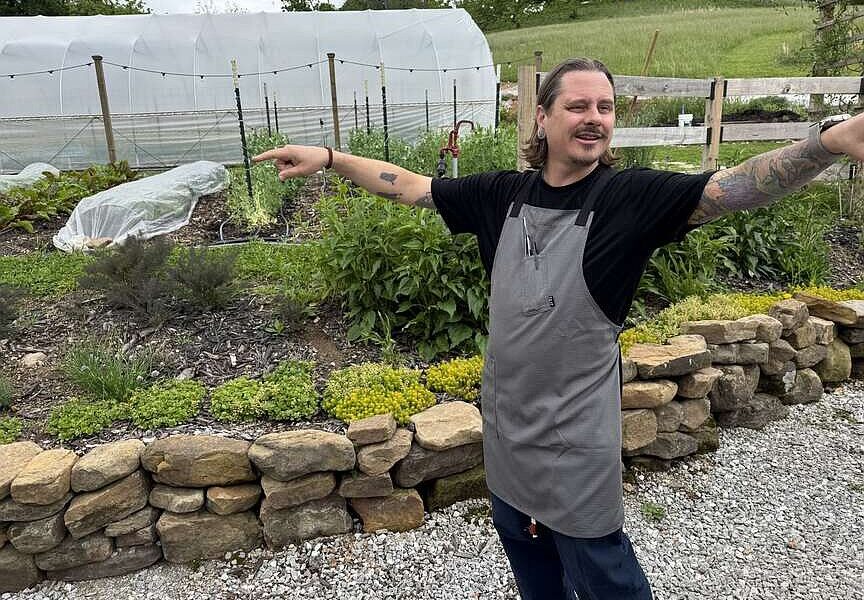
“I’ve always believed that the best food comes from the best relationships,” Cooper said during a recent tour of Sun Painted Farm, a Bentonville grower that supplies Ryn with herbs, greens, and edible flowers. “If we’re going to build something lasting here, it has to be about more than just the food on the plate.”
Ryn is open Thursday through Sunday and seats 32 guests per night. Reservations often book weeks in advance. The restaurant’s fixed-price menu averages $125 per person, before drinks. Cooper and his team work with about 20 local farms and producers on a regular basis, including Prairie’s End Farm, King’s Roam, and Ozark Forest Mushrooms.
That sourcing model isn’t just about flavor — it’s about economics. Cooper said Ryn pays 30% to 40% more for local ingredients than it would for industrial equivalents. That premium, he said, is a deliberate investment in the region’s food system.
“We’re trying to prove that there’s a market for high-quality, locally grown food,” he said. “And that if restaurants are willing to pay a fair price, farmers will grow it.”
Cooper’s approach reflects a broader shift in Northwest Arkansas, where a growing number of diners are seeking out locally sourced meals — and where institutions like the Winthrop Rockefeller Institute have emphasized regional food systems as part of community development.
Before opening Ryn, Cooper worked in kitchens across the U.S., including stints in California and New York. He returned to Arkansas in 2011 to help launch the culinary program at the University of Arkansas. That role led to consulting work with local restaurants and, eventually, a desire to open something of his own.
“I wanted to create a restaurant that reflected where we are — not just geographically, but culturally,” he said. “This isn’t California or New York. It’s Northwest Arkansas. And there’s something unique here that deserves to be celebrated.”
Ryn’s menu changes with the seasons, but dishes often feature native ingredients like pawpaw, persimmon, and sassafras. The restaurant also hosts monthly community dinners, educational workshops, and collaborations with local artists. Those events, Cooper said, are part of Ryn’s mission to function as more than a dining room.
“We’re not just feeding people,” he said. “We’re trying to bring people together.”
The restaurant employs 14 full-time and part-time staff. Cooper said he pays above-industry-average wages and offers health benefits to full-time employees. He also covers employees’ continuing education, including culinary school and conference attendance.
Cooper’s work has drawn regional attention. He’s been a semifinalist for the James Beard Award for Best Chef: South multiple times, most recently in 2024. But he said the recognition is secondary to the work itself.
“The awards are nice, but they’re not why we do this,” he said. “We do this because we believe in the community we’re building — and because we want to show people what’s possible when restaurants and farms work together.”
Source: NWA Democrat Gazette