Smoke N’ Bones BBQ closed its West Little Rock location on Cantrell Road after only a few months, citing the need for more space to support its operations. The barbecue restaurant has since reopened in Conway, marking a shift in its physical presence within central Arkansas.
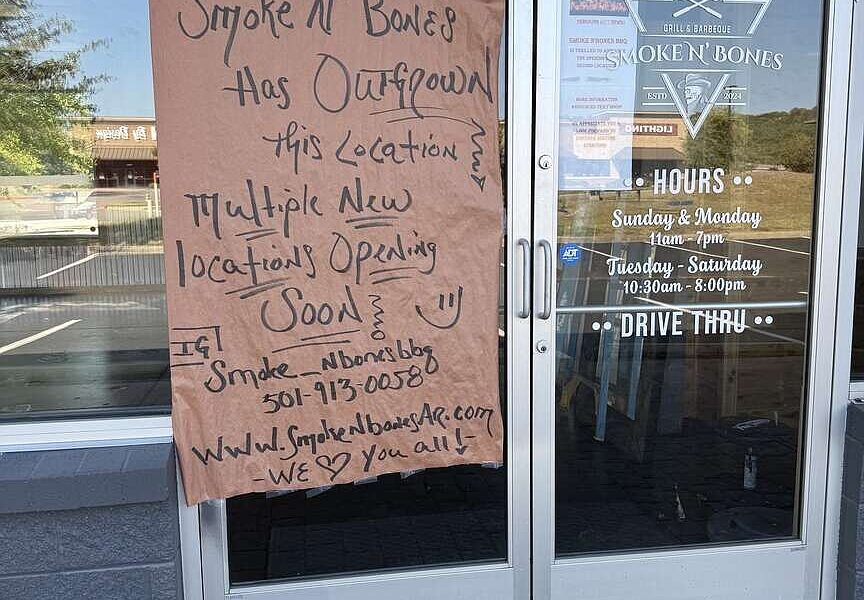
The restaurant initially relocated into a former Burger King building in West Little Rock earlier this year. Despite the short duration there, signage at the Cantrell Road site announced that Smoke N’ Bones had “outgrown” the space, a message reinforced by the company’s decision to move once again.
Smoke N’ Bones’ move to Conway comes amid a competitive barbecue market in Arkansas, one where location and kitchen capacity can significantly influence a restaurant’s ability to serve customers efficiently. The new site in Conway offers increased square footage compared to the West Little Rock location, allowing the business to expand its kitchen and dining areas to better handle demand.
Details on the new facility’s size or exact address in Conway have not been disclosed publicly. However, the shift signals Smoke N’ Bones’ prioritization of operational scale and customer service over maintaining its recent Cantrell Road spot.
The restaurant’s original opening in Conway held significance for the brand before its brief tenure in West Little Rock. Returning to a community with a strong local customer base may serve to stabilize Smoke N’ Bones’ business following the transitional period.
Barbecue remains a competitive segment in Arkansas dining, with many restaurants balancing traditional techniques with business scalability. Smoke N’ Bones’ decision to leave West Little Rock after only months is relatively uncommon in the region but illustrates the challenges smaller operators face when adjusting to rapid growth expectations.
Local business observers note that the former Burger King building on Cantrell Road was a convenient but compact location, which likely constrained Smoke N’ Bones’ ability to prepare and serve food at peak times. Nearby, other barbecue establishments with larger kitchens continue to compete for market share, making efficiency critical.
Conway has positioned itself as a growing hub for regional dining, and Smoke N’ Bones enters this market with the potential to reach a wider audience. The move could tap into the city’s expanding population and the increased demand for specialty barbecue offerings. It may also reduce logistical constraints related to cooking infrastructure and customer seating capacity.
Smoke N’ Bones’ transition follows a period of growth and experimentation typical for regional restaurants seeking to balance quality and volume. While the West Little Rock site’s closure might appear abrupt, the move to Conway suggests a strategic recalibration to align their physical capacity with customer expectations.
For patrons in Northwest Arkansas who previously frequented Smoke N’ Bones in Little Rock, the move requires adjustment but may result in improved service quality. Conway’s location is positioned to provide a more spacious dining experience and accommodate higher volumes of barbecue production.
The reasons given for leaving the West Little Rock site—primarily outgrowing the space—highlight the operational limitations that can challenge barbecue restaurants in urban commercial real estate. The Cantrell Road facility’s prior use as a Burger King may have limited Smoke N’ Bones’ ability to modify the kitchen layout and customer areas to suit their needs more fully.
As Smoke N’ Bones settles into Conway, it remains to be seen how the restaurant will carve out its market niche alongside established local competitors. Arkansas barbecue enthusiasts often prioritize authenticity and consistency, meaning the business will need to manage both food quality and operational efficiency carefully.
Smoke N’ Bones’ journey from its brief West Little Rock presence to its reestablished location in Conway reflects broader themes in the regional restaurant industry: the intersection of space, customer demand, and business model scalability. How well it adapts could influence its longevity and reputation in the Arkansas barbecue scene.
Source: NWA Democrat Gazette