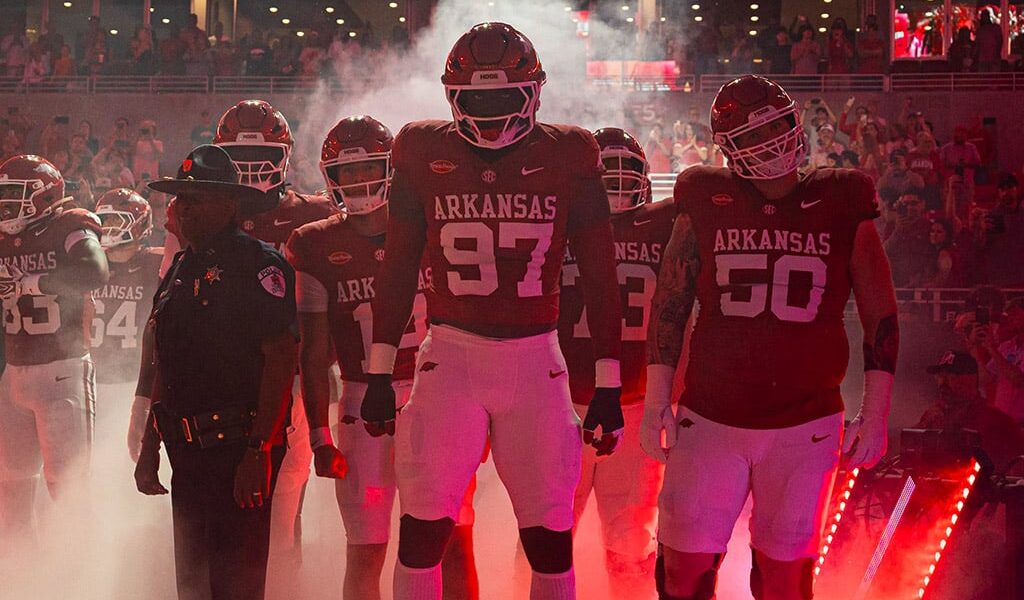
The Arkansas Razorbacks will face the Texas A&M Aggies Saturday in College Station, continuing a long-standing series marked by significant shifts in dominance and conference affiliations. The matchup holds historical weight given both programs’ intertwined past and recent competitive trends that challenge the traditional perception of this rivalry.
Arkansas and Texas A&M were founding members of the Southwest Conference (SWC) in 1914, competing annually until Arkansas left the SWC after the 1991 season to join the Southeastern Conference (SEC). Texas A&M, along with Texas, Texas Tech, and Baylor, stayed behind before breaking from the SWC in 1996 to help form the Big 12 Conference through a merger with the Big Eight Conference.
Texas A&M joined the SEC in 2012, aligning the Aggies once again with Arkansas after more than two decades apart. However, since the Aggies transitioned into the SEC, they have dominated the head-to-head series, winning 13 of the last 14 games against the Razorbacks. Arkansas had predominated the series before Texas A&M’s SEC entry. This dramatic reversal has led to questions about whether the rivalry remains balanced or competitive.
The Razorbacks have struggled to regain footing against the Aggies, who have used their momentum and recruiting advantages within the SEC to build a consistently successful program. Texas A&M’s football program, bolstered by strong donor support and high-profile coaching hires, has put Arkansas on the back foot in recent contests. Meanwhile, Arkansas continues to work through coaching changes and rebuilding efforts under head coach Chad Morris, who is in his second season with the team.
Texas A&M’s home-field advantage in College Station further complicates matters for Arkansas. Kyle Field is consistently one of the largest and most imposing stadiums in college football, routinely surpassing 100,000 in attendance during SEC matchups. This environment poses an additional challenge to the Razorbacks aiming to overturn recent trends and secure a breakthrough win.
This season, Arkansas enters Saturday’s game with a 2-3 record, grappling with injuries and inconsistent offensive output. Texas A&M, meanwhile, holds a 3-2 record and has shown resilience through a physically demanding SEC schedule. Both programs have not met expectations this year, evident in their sub-.500 win percentages, which adds another layer of complexity to this game beyond historical rivalry narratives.
Since Arkansas’ SEC entry in 1992, the Razorbacks have encountered a more intense level of competition within the conference, which has included powerhouse programs such as Alabama and LSU. Texas A&M’s move to the SEC put them on a similar path, but their financial investment in facilities and recruiting has arguably accelerated their competitive ascendance relative to Arkansas.
Despite the Aggies’ dominance in recent years, the long history between the two schools maintains a certain significance regionally and among fans. These programs share cultural and fanbase ties that extend beyond football, encompassing academic collaboration and statewide pride. The rivalry also captures attention in Northwest Arkansas due to its proximity and the shared history of conference affiliations over the past century.
Strategically, Arkansas will need to improve defensive pressure and execute offensively to disrupt Texas A&M’s rhythm. The Aggies’ defense ranks among the more efficient units this season, while their offense balances a veteran quarterback and dynamic skill players. The Razorbacks’ ability to protect their quarterback and contain explosive plays will be critical for keeping the game close.
This meeting at Kyle Field also illustrates how conference realignment shapes college football rivalries today. While the Southwest Conference housed both programs for decades, their paths diverged, only to intersect again with the 2012 SEC reshuffling. This phenomenon reflects broader shifts in college athletics, where traditional rivalries must adapt to changing landscapes.
Saturday’s game presents an opportunity for Arkansas to reverse recent fortunes against Texas A&M and restore competitiveness in a historic matchup. For Texas A&M, sustaining the advantage and reinforcing dominance is equally important. Regardless of the current records, the game holds implications for recruiting leverage, SEC positioning, and future scheduling decisions.
The Arkansas-Texas A&M football game kicks off Saturday at 7 p.m. Central Time at Kyle Field in College Station, Texas. The outcome will serve as a barometer for both programs amid an uneven season and evolving SEC hierarchy.
Source: Fayetteville Flyer