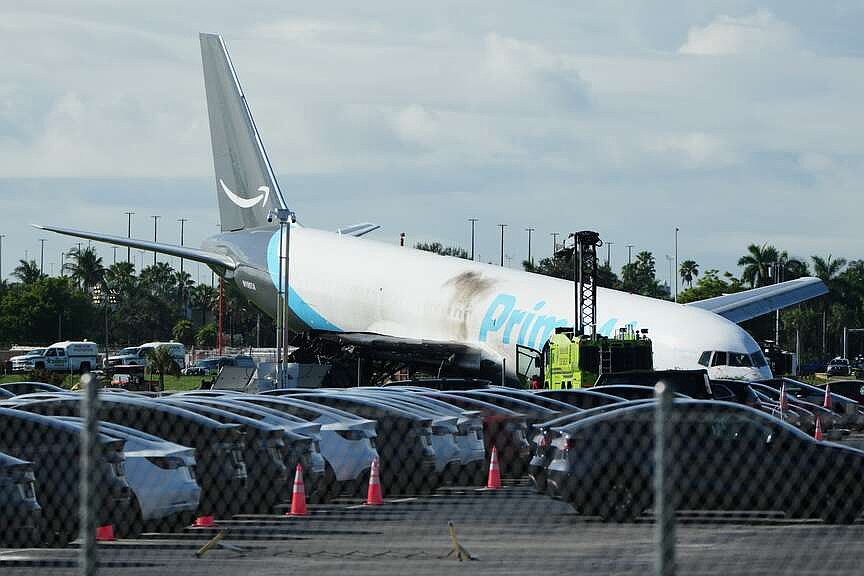
The National Transportation Safety Board is investigating a deadly crash involving an Amazon cargo jet and two vehicles near Miami International Airport that claimed five lives Sunday. All five victims were passengers in a van belonging to a cleaning company, one of seven people inside at the time of the accident, National Transportation Safety Board Chairwoman Jennifer Homendy confirmed Monday.
The Boeing 767 cargo plane veered off the runway during landing, leaving a path of wreckage that extended approximately 1,300 feet from the paved surface into the grass. Along this course were tire marks, a destroyed van that had been carrying cleaning staff, torn airport fencing, navigational equipment, and a crushed SUV just outside airport boundaries. Homendy described the scene as “utter devastation.”
Details remain limited about the SUV occupants and how many people were inside. The crash site was littered with debris from the airplane, vehicles, and airport infrastructure, including airbags and fencing knocked down by the collision. The cleanup and investigation are ongoing as authorities work to determine what led to the Amazon jet’s runway overshoot, an incident with tragic consequences.
Frankly, incidents involving cargo aircraft aren’t common in a major airport hub like Miami’s, where stringent safety and operational protocols usually keep things running smoothly. Still, this heartbreaking event underscores the risks inherent in busy transportation environments intersecting with ground operations, including vehicle traffic near runways. In a city like Miami, the complexity of coordinating aircraft movements and ground vehicles is immense; for a place like Northwest Arkansas, with smaller airports and less traffic, the scale differs but the stakes of safety remain just as high.
For residents of Northwest Arkansas, reporting on this crash serves as a reminder of the profound danger that can accompany aviation and transport workforces — including support jobs like cleaning crews, which often must operate under tight schedules and in challenging conditions. Sadly, the five victims were among those helping keep airports functional behind the scenes.
While Miami is miles away from NWA, aviation safety concerns touch us all, especially as Northwest Arkansas continues to grow and airport activity inches upward. The Northwest Arkansas National Airport (XNA) has steadily increased flight operations over recent years, so local leaders and the public are wise to keep an eye on transportation safety developments nationwide.
The NTSB investigation team will be sifting through everything from aircraft performance data, pilot actions, airport vehicle movements, and environmental conditions to piece together how this collision unfolded — a process that could take weeks or months. Meanwhile, the families of those lost in the cleaning company van face an unthinkable tragedy.
Incidents like these also raise questions about airport security zones and the coordination between ground vehicle operators and air traffic control. How cleaning crews move about active airports, the physical barriers protecting runways, and the protocols for vehicle movements in close proximity to planes could become areas of increased scrutiny nationally.
Here in Northwest Arkansas, the focus on safe and efficient airport operations should reflect these lessons. As more workers, passengers, and goods move through XNA and surrounding facilities, investments in training, communication technology, and infrastructure to prevent crashes like Miami’s are increasingly critical.
The National Transportation Safety Board’s thoroughness in investigating this deadly crash will hopefully lead to improved safety recommendations that airports nationwide can adopt. And while the Amazon cargo plane crash happened far from here, its impact resonates across the aviation community — including those of us in Northwest Arkansas who know the value of every single role that keeps airports flying smoothly.
Source: NWA Democrat Gazette