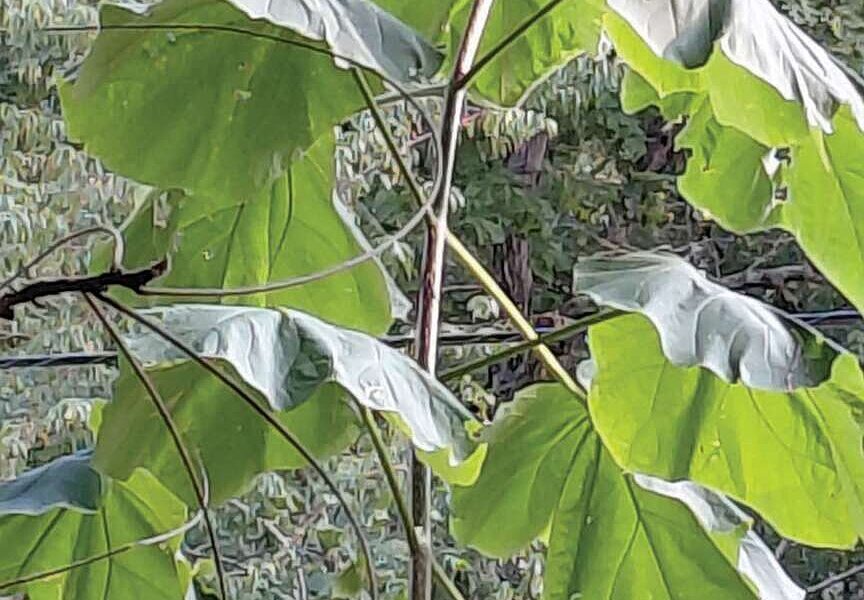
Laurie German, a resident of Bella Vista, is asking local residents to help document invasive princess trees—one of Northwest Arkansas’s most aggressive landscape invaders—by uploading photos of them to the citizen science platform iNaturalist. German, who points out the non-native species comes from China, says a future eradication project relies on knowing exactly how widespread the infestation is. The primary directive for anyone encountering these trees is straightforward: observe them from a distance, and do not cut them down. “If you cut them down, they will multiply,” German explains. She warns that this setup is a biological trap. Unlike a standard tree removed from a yard, a princess tree does not easily give up the fight. Sever the trunk, and the roots often send up dozens of new shoots. Chop the roots, and the tree generally springs back stronger. Local land managers in Benton County have long battled the return of this non-native, and the strategy is simple: avoid the mistake of planting it. The princess tree—botanically known as Paulownia tomentosa and sometimes called empress tree—was popular for decades as an ornamental street tree. It found its way into many front yards and rural fence rows before its invasive nature became apparent. It grows with a vigor that outpaces our native oaks and hickories. By casting a dense shade, the princess tree shuts out sunlight that young, native saplings need to survive, essentially taking over the forest floor. They are visually striking when they bloom. Fluffy, lavender or purple flowers appear in late spring, signaling the start of a rapid growth spurt. By summer, the leaves can be four to six feet long, creating a canopy so heavy it can break branches during windstorms. But their beauty is directly tied to their dominance. The tree drops seeds “explosively,” scattering thousands across the landscape each year. Because the seeds land so far from the parent, they can establish colonies deep in the woods, away from where a homeowner might initially plant one. Over time, these colonies push out local wildlife habitats and change the chemistry of the soil. German’s vacancy-detection project is a practical way to gather data before boots are on the ground on a cleanup crew. Homeowners in Arkansas City, Cane Creek, Pea Ridge, and High Ridge areas need to keep an eye out for the characteristic large, heart-shaped leaves and rough, hairy bark. By logging the location via the iNaturalist app, users turn a nuisance sighting into scientific data. This information will be vital for determining if a wider-scale biological control or mechanical removal is feasible without causing neighbors more trouble. The warning about not cutting the trees is not just an aesthetic preference; it is a biological necessity. Halting the spread is the only way to stop the princess tree from further insinuating itself into the natural
Source: NWA Democrat Gazette