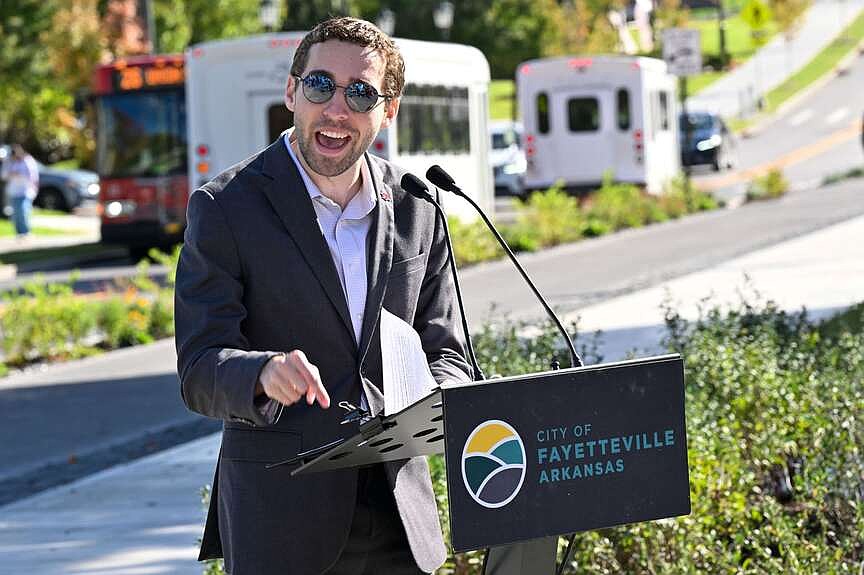
City officials and University of Arkansas leadership cut the ribbon Friday on the $11 million Maple Street improvements, marking the completion of a two-year project designed to separate bicyclists from vehicle traffic and address long-standing drainage issues in the corridor between the Razorback Regional Greenway and Garland Avenue.
Project stakeholders emphasized the redesign of the half-mile corridor prioritizes the safety of students, faculty, and residents over the volume of automobile travel. The scope of work involved narrowing general traffic lanes to reduce crossing times for pedestrians and installing a dedicated two-way protected bicycle path.
Logan Williams, president of the University of Arkansas student body, addressed attendees at Friday’s ceremony. Williams highlighted the immediate benefit the upgrades provide to the campus community, noting that the new configuration lowers the risk of collisions and offers a direct route for cyclists heading toward campus and the nearby medical complex.
The Maple Street project departs from standard urban arterial design in favor of data-driven street safety tactics. Unlike a standard four-lane road, the renovated segment features “raised” intersections and bulb-outs that extend the sidewalk into the street. This physically narrows the crossing distance for pedestrians riding scooters or walking, making them more visible to drivers approaching from either direction.
Funding for the overhaul, managed in partnership between the City of Fayetteville and the University of Arkansas, covered more than just pavement. City documents indicate the budget included significant upgrades to underground drainage systems to mitigate flooding that frequently impacted the corridor during heavy rainfall events. The construction also addressed grassed medians, installing landscaping that removes visual barriers and improves sight lines for crosswalk users.
The transition from a vehicle-centric corridor to a multi-modal thoroughfare effectively extends the reach of the Razorback Regional Greenway. The project connects the equestrian and hiking paths in Springdale directly to urban infrastructure in Fayetteville, supporting regional goals to increase active transportation options.
While the ribbon-cutting signaled the immediate availability of the new facilities, city and university maintenance staff will continue to monitor the transition. Adjustments to signal timing and pedestrian behavior may be necessary as drivers adjust to traffic calming measures that limit through-traffic speeds.
The completion
Source: NWA Democrat Gazette