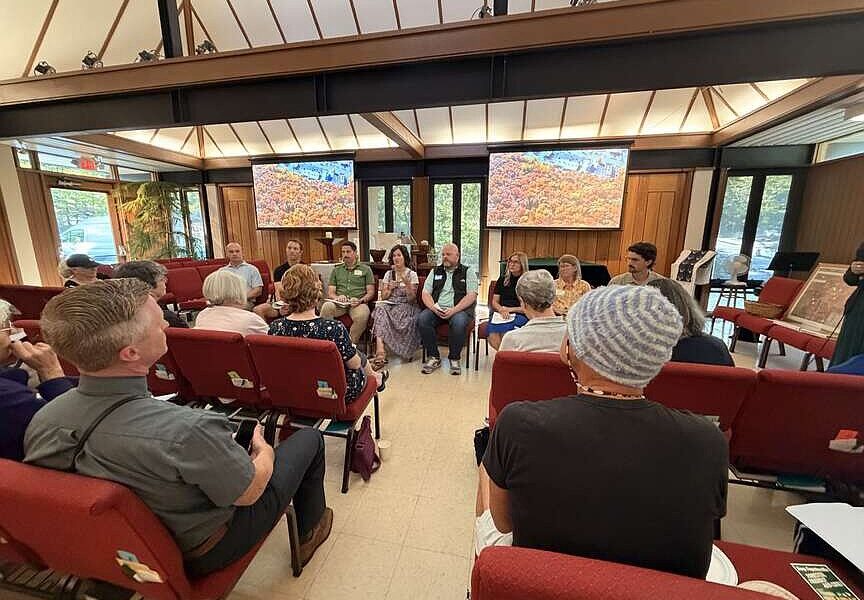
Fayetteville City Council candidates spoke Sunday about key local policy issues, including the Enduring Green Network, potential revisions to the city’s Unified Development Code, and recent controversies around non-disclosure agreements and the proposed aquatics center.
The discussion took place during a question-and-answer session organized by the Fayetteville Natural Heritage Association at the Unitarian Universalist Fellowship. Eight of the nine candidates vying for seats in the Nov. 3 election attended.
The Enduring Green Network, a city initiative aimed at protecting natural and open spaces, was a focal point. Candidates expressed varying views on how to balance conservation with development pressures as Fayetteville continues to grow.
Several candidates emphasized the importance of preserving green corridors and maintaining connectivity between parks and natural areas. One candidate highlighted the network’s potential to increase residents’ quality of life while sustaining biodiversity in Benton County. Others noted that development regulations must be clear and flexible enough to accommodate economic growth without compromising environmental goals.
The Unified Development Code (UDC)—the comprehensive set of zoning and land use rules that guide Fayetteville’s growth—was another topic of discussion. Candidates generally agreed that the UDC should undergo updates to address changing community needs and clarify regulations that have sparked debate among developers, homeowners, and environmental groups.
Some candidates advocated for more community input in the code revision process, aiming to create a transparent framework that responds to public concerns. Others proposed streamlining certain provisions to reduce ambiguity and delays in permitting, which they said can hinder local business investment and job creation.
Recent scrutiny around the use of non-disclosure agreements (NDAs) by the city government also surfaced. Candidates were asked to comment on whether NDAs should be used in public affairs, especially regarding issues that carry significant public interest.
Most candidates agreed that transparency is critical in local governance. A few acknowledged that NDAs might be appropriate in limited circumstances but cautioned against overuse that could undermine public trust. The discussion underscored community demand for accountability in city decision-making.
The proposed aquatics center—a project under city consideration to expand recreational infrastructure—elicited mixed opinions. Candidates recognized the potential for an aquatics center to promote health and boost local economy through increased tourism and events. However, concerns were raised about funding sources, operational costs, and long-term financial impacts on Fayetteville’s budget.
Some candidates advocated for thorough feasibility studies and community engagement before advancing the project, emphasizing prudent stewardship of taxpayer dollars. Others stressed that amenities like an aquatics center can attract families and improve quality of life, key components of Fayetteville’s growth strategy.
The candidate forum reflected the complex challenges facing Fayetteville as it balances growth, environmental stewardship, and fiscal responsibility. The session offered voters detailed insight into where candidates stand on issues that will shape Fayetteville’s development trajectory in the coming years.
Fayetteville’s upcoming City Council election on Nov. 3 will determine the city’s direction on these matters. The elected council will oversee updates to development regulations, decisions related to public amenities like the aquatics center, and policies affecting transparency and community engagement.
More information about candidates’ platforms and local government initiatives can be found through Fayetteville’s official channels and local news outlets.
Source: NWA Democrat Gazette