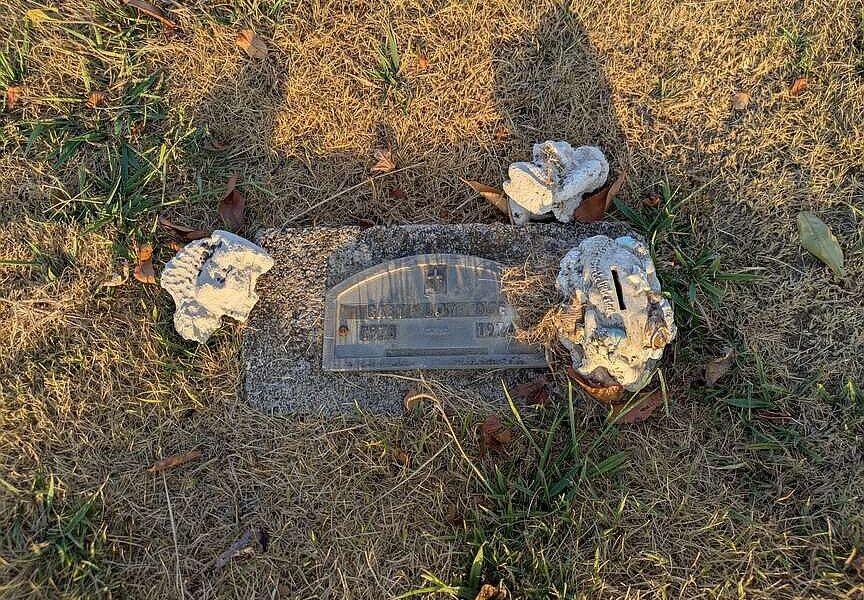
The Benton County Sheriff’s Office is preparing to exhume the remains of an infant known locally as “Baby John Doe,” who was found nearly 50 years ago in the woods near Springdale. The case, cold since 1977, has resurfaced as investigators attempt to finally identify him and uncover what happened in those early, unresolved days.
The infant was discovered on April 16, 1977, by hunters roughly 5 miles outside Springdale. The child’s remains, presumed to be male, were buried with a simple grave marker at Bentonville Cemetery. The gravestone, worn but legible, reads “Baby Boy Doe 1978-1978,” reflecting the unknowns around his true identity and exact birthdate. For decades, “Baby John Doe” was a placeholder name used by the Benton County Sheriff’s Office, symbolizing both the mystery and the hope for answers.
Now, almost five decades later, the sheriff’s office is moving forward with an exhumation. One early and crucial concern is whether the infant’s remains are still contained within the original casket. Sheriff’s representatives explained that the casket’s condition is unknown, given the passage of time and potential disturbances at the gravesite. Any decay or damage could complicate forensic testing, which law enforcement hopes will lead to a positive identification.
The sheriff’s office has declined to provide specific details on what prompted the renewed investigation. However, advances in forensic science, especially in DNA technology, are likely the driving force behind the effort to finally put a name to “Baby John Doe.”
Local residents who frequent Bentonville Cemetery can still see the modest headstone standing beside the East Slope section, a quiet part of the cemetery nestled away from the busy streets like Walton Boulevard and Military Road. The spot has been the site of occasional, respectful visits from those connected to the case or curious about the story behind the name.
Though cold and decades old, the case remains one of the few unidentified infant remains in Benton County. The inability to identify and provide closure has weighed on sheriff’s office personnel and the community. Those charged with investigating hope that with modern DNA testing methods — such as genealogical databases and mitochondrial DNA analysis — they can find family members or at least some traceable genetic markers.
Efforts to identify the child may also involve checking missing persons reports from the late 1970s, including local records and any leads that could connect to families who reported infants gone missing in the region during that time. Authorities have not publicly released any names or specific leads in order to protect family privacy if a match is found.
The case has drawn attention from local advocates and those interested in cold cases and unidentified remains in Northwest Arkansas. It’s a somber reminder of how many questions can remain unanswered even amid the growth of Bentonville and the larger metropolitan area over the last half century.
Springdale’s development, along with the neighboring cities of Rogers and Fayetteville, has dramatically changed the landscape since 1977. But the woods where the infant’s body was found remain a haunting piece of history for Benton County law enforcement.
Those familiar with the case acknowledge how difficult it is to dig into something so old, especially when original evidence and witnesses may no longer be available. Still, the sheriff’s office said the exhumation and investigation are necessary steps toward providing long-overdue answers.
Once the remains are exhumed, forensic specialists will examine them thoroughly before any attempts at identification through DNA or other means. If successful, this could offer a measure of closure for a case that has lingered quietly in public memory.
In the meantime, officials ask the public for any relevant information related to missing infants or unusual activity in the 1970s in Benton County. Anyone with information is encouraged to contact the Benton County Sheriff’s Office directly.
This case joins other efforts in Northwest Arkansas where cold cases have recently been reopened or resolved thanks to advances in forensic science. Earlier this year, several agencies across the state have leveraged DNA databases to identify remains from decades-old investigations, bringing renewed hope to families and communities.
For now, the focus remains on the exhumation, scheduled for the coming weeks. Investigators will work carefully to preserve as much evidence as possible. The success of this attempt could be a pivotal moment in Benton County’s effort to resolve one of its longest-running mysteries.
Source: NWA Democrat Gazette